Showing posts with label Inquiry 2018. Show all posts

Monday, 17 December 2018

Inquiry 2018: End of Year DMiC Reflection.

We were told at the beginning of our DMiC journey that we would need to be patient to see the results of introducing a new type of collaborative problem solving based maths programme.  As teachers we often want to "fix" a problem immediately.  We teach and then assess and expect what we have taught to have been absorbed and the problem is now "fixed".

Our mentors were so right to tell us not to expect results immediately.  Not only were the children learning a whole new way of participating in a maths lesson but so were we as teachers learning new "talk moves", how to write engaging questions, how to scaffold but not lead discussions, teach the norms and know how to ask open ended questions and to try and engage all learners when some did not wish to be engaged or did not have the necessary maths knowledge to help their group even with simple counting on materials.

By the end of Term 2, I was already seeing a change in the maths thinking of some children.  They were beginning to ask "rote" questions and they were prepared to be patient and work with a small group, following group norms and having some good discussions.  Not every maths lesson was successful but I could see that there were more successful lessons than unsuccessful.  Some children were able to give an answer to a problem but they found it hard to make their reasoning "visible" to others.  Explanations were often a simple "because..." with no real logical answer.  A sort of "I know so why don't you not know as well."

Terms 3 and 4 still left me trying to engage my reluctant learners and worrying how these children would gain number knowledge.  The mentors said that children would gradually become more engaged and that they would "learn on the job" and this is exactly what did happen.  When I used the JAM test at the end of term 4 I was pleasantly surprised to formally assess their knowledge.  I had seen children extend their number knowledge, quickly count in 2s and 5s and share things equally when solving problems but to be able to look back at previous results and see just how much progress was made was satisfying.

A snap shot of  priority learners to show their increase in Add/sub and number Id. 
The participation of children in the discussions showed a marked improvement through out the year with some children becoming very proficient at explaining their ideas in a clear and logical way and needing just a small amount of support to do so after all they too have been learning how to use language to hold a mathematical discussion.  There was far more "green" on the Term 4 data as well as some "grey" whereas there was far more "red" with a small splattering of "brown" in term 1.

Term 1 and 2 participation


Term 3 and 4 Participation


For those children who can use the norms and listen to other children's reasoning (not arguments) then persuade others that there might be another way of looking at the problem it is great to see the progress they have made.  In a recent problem I had a picture of a pattern built using Duplo blocks.    The challenge was to guess how many blocks were used without counting the blocks one by one.  I thought they might be able to find two solutions but they surprised in finding seven solutions before we ran out of time.  These included being able to see that some of the solutions were repeated addition, groups of 10, symmetry of groups, multiplication (groups of) and the commutative law.  Given time to work collaboratively through this problem they were able to see different possibilities and share their thinking to help others see another possibility. The debriefing at the end also helped others see the possibilities.

All this also shows the development of the children's language.  They try to give logical explanations and use mathematical terminology to be more precise in their descriptions of what they have found not just give a vague wave of the hand over a drawing.  They are encourage to ask questions (although many are still what I call "rote" questions because they find difficulty in framing a question and building their reasoning skills).  The norms of having a discussion with one person talking and the other group members listening and giving others time to think, has flowed through to other areas of classroom discussions.  I will certainly be introducing the norms early on in maths next year to get DMiC maths off to a flying start as well as using it in class discussions in other areas to show that this is the way we have a discussion.

Using the maths wall as a warm up each day has helped children learn shapes and to think about why I have grouped certain shapes together.  It is no longer enough to say a vague "because..." but they are trying to explain their thinking using every day language such as "four corners" or "one long side".  Fractions, before and after, subitizing of numbers, tens and ones, counting in 2s, 5s and tens all help show maths and the language it uses is all part of our life and is not something too difficult and to be avoided at all costs.

It is exciting to come to the end of the first year and to realise how the expectation that everyone contributes  and encourages others in DMiC maths has helped in the acquisition of language.


Saturday, 8 September 2018

Inquiry 2018: Not Maths But Using Language

I have been thinking about how I motivate my students to write and felt it was time to try something new.  The children practise writing stories most days with a variety of motivation but I felt there needed to be more noticing of things like language used, attempted spelling using alphabet sound knowledge and even using punctuation and gaps between words.

To begin, I let the children choose what they would like to take a photo of.  This meant that they had to remember how to take a photo by going into a blank page in EE and using the camera to take a photo, crop it and then lock it up the top of the page.

The next step was to think of two sentences to write about their chosen picture.  They were able to factually record something or use their imagination and predict what might be going to happen in the picture.  The children were very engaged on the task, so much so that chatter all but ceased as they worked away to think of a sentence and write it down. They wanted to get that part of the task over so that they could begin to type and see what their story looked like all neatly typed.

Not all of the children had previously used typing so I took groups and showed them how to type.  Again this required concentration to find the correct letters, put spaces between words, use capital letters and full stops and lock the text under the picture.  When they finished I put their work up on the Apple TV which spurred those still typing to finish the task.  They were very proud of the new skills they had learnt as well as the stories they had produced.  They enjoyed having an audience for their work and reading it out to others.

It was an exciting exercise that engaged the children and got them not only using language but also their digital skills.  They were able to learn new skills, create a story digitally and share it with their class mates.

Tupou chose to write about a sealion.
Alexandra wrote about a puppy in a reader.
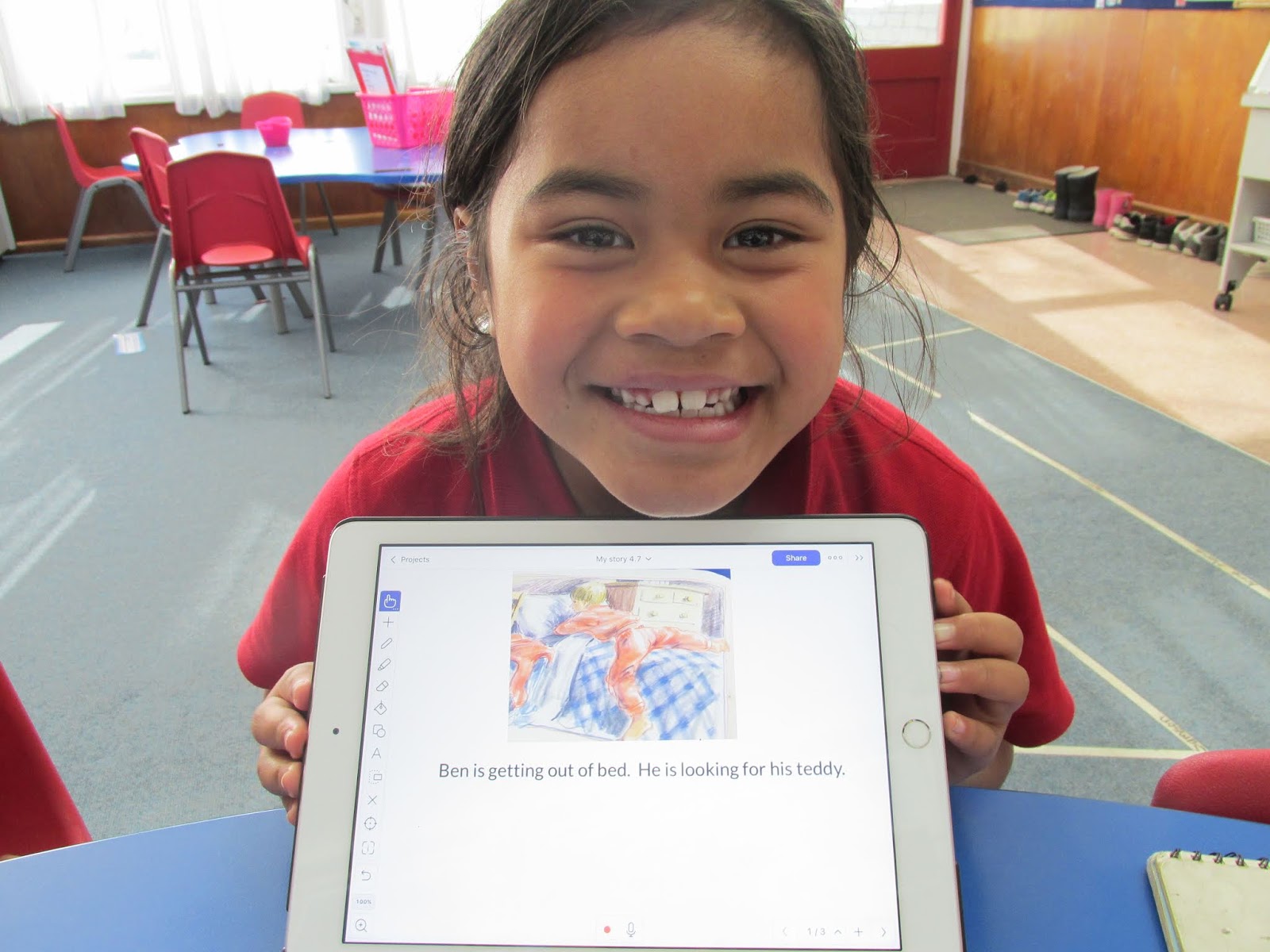
Maggie liked the story about Ben and his teddy.

Chevelle wrote about Little Bear riding Monkey's big bike

Wednesday, 4 July 2018

Inquiry 2018. Term 2 Reflection.

My 2018 Maths Inquiry is based around encouraging children in the acquisition of language and using this language to participate in Maths sessions.

The DMiC lessons have been a great way to encourage the use of language.  Not only do the children have to work collaboratively to solve a problem but they have to communicate their thinking to a partner or explain their solution to the class.  This means they have to understand what the question is asking them to do, as well as being clear in their own thinking what the series of steps were that they took to reach a solution.  They need to ask questions to seek clarification and understanding.


We have been very fortunate in having DMiC mentors visit the school to help the teachers implement this new method of problem solving.  They are able to help us use appropriate "talk moves" and to discuss techniques that might work for our particular children.

When thinking about how my class is tracking I find they fall roughly into three groups.  There are those who are enthusiastic and attempting to participate fully in the lesson.  They are trying to use the correct language and put their thoughts into a logical order.  The next group are still observing and will occasionally participate but have difficulty in forming questions to increase their learning.  They are still learning how to work as a group and how to find out and remember what the question is asking them to do.  Lastly I still have some children who will not engage at all.

Trying to measure or quantify this shift (or lack of shift) into some visual form has proved challenging.  Two other colleagues were also trying to come up with some form of measurement and together we came up with a rubric that the children could also use to see what the expectation was in speaking and participating in Maths.


 Based on the colour coded 5 levels of participation I then made up a spread sheet of my class.


This gives me a clear visual indication of those children who are speaking and attempting to  participate in maths and for those that need further help to engage in the programme.  It is a broad indication and priority learners are monitored more closely by trying to look at talking, listening and responding.


There has been some movement but not as much as I would like to see.  Each day we use our maths wall in our daily Maths warm up as a reference point with discussions arising from changing displays such as subitize dot patterns, tens frames, finger patterns, shapes and so on.  Some of the comparative language of size has been used in their stories but it has been disappointing to see it used sparingly other than at Maths time.

During DMiC maths the use of questions is limited.  Even with constant modelling this is something that our children find hard.  When working with others, some groups get bogged down arguing about what drawing they will use to represent the numbers in the question instead of thinking about what the story is asking them to find out.

I am also finding it hard to use the correct "talk moves" to illicit thinking which will help the children see a method of solving the problem without giving them an answer.  We as teachers so often "teach", so it is hard to let children explore options.

We are still at the beginning stage of our maths journey but we are learning so much along the way.


Sunday, 25 February 2018

Manaiakalani COL Achievement Challenge 2018.

The Manaiakalani  COL Achievement Challenge that I am basing my 2018 Inquiry around is to lift achievement in maths of my Year 1 students.

My inquiry will focus on the role of language in mathematics and how this language can be "normalised" and transferred into other areas of the curriculum and relates to their everyday conversations and usage.

Year 1 students often lack the verbal tools to begin to look at a maths problem or to justify concepts of how they solved a problem so they are less likely to participate in a maths lesson, remaining silent or shrugging their shoulders and therefore do not make as much progress in maths as they are capable of. 

They switch off saying they "can't do maths"  but what they really mean is "I can't find the right words to explain what I am suppose to do and how I did it."

I propose to look at the role of language in mathematics and how I can support my students to acquire this language and thinking that they need to raise their achievement.