On Wednesday 20 February Betsy Sewell gave a presentation on Phonemic Awareness to the Junior school. This discussion was very pertinent as we have so many children who struggle with reading. It sounded as if this could be one area that we could use her findings to help these children to gain a love of reading and to be competent, fluent readers who could think about what they are reading and answer comprehension questions.
She began her presentation by explaining how complex and challenging English language is with 40 plus sounds but we only have 26 letters thus many sounds are represented by 2 or more letters. To further complicate things English has words that come from Old English, French, Latin and Greek - a sound maybe represented by "sh" in old English maybe written using the letters "ch" in French or "ti, ci, si, su or ud" in Latin! We also have letters in English that our students do not have in their first language.
We need to learn the patterns of letters and the sounds they make to be able to make sense of words. Being able to decode may be adequate with reading but the skills involved in decoding break down for spelling. This is because the link between the spoken word and sounds is different.
In a spoken word sounds may not be emphasised so heavily. We run sounds together and often children do not hear where one sound begins and another ends. Maybe a child had glue ear when they were learning to speak and could not differentiate the sounds. Saying a word slowly can help a child notice how the mouth is held for different sounds. Some pairs of letters such as "p" and "b" may sound similar but there is a difference in how you say them. By learning how sounds go together they can see that there are repeated patterns in chunks, blends or substituted sounds. Children who have difficulty detecting some of the tricky sounds need to be taught strategies that work for them and then practise, practise until it is secure.
In print, letters are necessary seperate and discreet. This knowledge of thinking in sounds and patterns can then be transferred into reading. A competent reader may pause at an unknown word as he notices and absorbs the word, thinking of the differences and how he can put the chunks together using his sound skills, having developed a mental agility to manipulate sounds and make substitutions instantly and effortlessly. He can also use emphasis and expression and think about comprehension because he knows the strategies to use. A struggling reader can not do this automatic processing of sounds and finding patterns. It is unnatural, not instinctive, and leads to the default of guessing. As a child works so hard on looking at the words their comprehension is compromised.
A struggling reader will often invent their own spelling when they write, maybe as they say it. They will try and think of how it looks, look at the Teacher for clues, look somewhere else and hope they will be "rescued" by the teacher who might know that the child has trouble with a particular sound such as "ph" and "f" sounds and always writes "with" as "wif" and will interpret for them.
The essential skills around sounds and words need to be in place for efficient decoding and spelling. They need to be able to -
* detect individual sounds in words and identify them
* represent them in print
* manipulate and blend sounds
* be attuned to patterns and chunks
While these strategies may apply more to the older reader who is struggling I am sure there is much that I can take from this presentation to help some of my year ones who find learning the high frequency words and even identifying individual alphabet letter sounds a struggle.
Thank you Betsy for your presentation.
Sunday, 24 February 2019

Wednesday, 13 February 2019
Research Presentation Of 2018 Data
The Manaiakalani schools meet on Tuesday 12 February to review the Woolf Fisher data from 2018 to help us set our Inquiry goals for 2019.
We looked at the data from 2018 to celebrate the successes we have had as well as to ask ourselves "What went well/ or not so well?" and "How can we build on this?" or "How can we replicate these results in another area of the school?" It is a great reminder to help us define our thinking and planning.
Rebecca gave us some interesting data about the junior area from the School Entry Assessments (SEA) that we do to all children after they have been at school for 5 or 6 weeks. There was wide variation on the number of letters that a child could identify according to the decile of the school (with our decile 1 children able to identify 17.4 letters while at a decile 7 to 9 school they could recognise 34.7) as well as the variation in the number of words a child could read.
A similar disparity occurs in other areas with our children shown to have to run so much harder to catch up. We have made a start on improvements in Maths and now we will focus on on how we can best provide strategies for our children in literacy as we plan and set goals for our classes in 2019.
We looked at the data from 2018 to celebrate the successes we have had as well as to ask ourselves "What went well/ or not so well?" and "How can we build on this?" or "How can we replicate these results in another area of the school?" It is a great reminder to help us define our thinking and planning.
Rebecca gave us some interesting data about the junior area from the School Entry Assessments (SEA) that we do to all children after they have been at school for 5 or 6 weeks. There was wide variation on the number of letters that a child could identify according to the decile of the school (with our decile 1 children able to identify 17.4 letters while at a decile 7 to 9 school they could recognise 34.7) as well as the variation in the number of words a child could read.
A similar disparity occurs in other areas with our children shown to have to run so much harder to catch up. We have made a start on improvements in Maths and now we will focus on on how we can best provide strategies for our children in literacy as we plan and set goals for our classes in 2019.
Monday, 17 December 2018
Inquiry 2018: End of Year DMiC Reflection.
We were told at the beginning of our DMiC journey that we would need to be patient to see the results of introducing a new type of collaborative problem solving based maths programme. As teachers we often want to "fix" a problem immediately. We teach and then assess and expect what we have taught to have been absorbed and the problem is now "fixed".
Our mentors were so right to tell us not to expect results immediately. Not only were the children learning a whole new way of participating in a maths lesson but so were we as teachers learning new "talk moves", how to write engaging questions, how to scaffold but not lead discussions, teach the norms and know how to ask open ended questions and to try and engage all learners when some did not wish to be engaged or did not have the necessary maths knowledge to help their group even with simple counting on materials.
By the end of Term 2, I was already seeing a change in the maths thinking of some children. They were beginning to ask "rote" questions and they were prepared to be patient and work with a small group, following group norms and having some good discussions. Not every maths lesson was successful but I could see that there were more successful lessons than unsuccessful. Some children were able to give an answer to a problem but they found it hard to make their reasoning "visible" to others. Explanations were often a simple "because..." with no real logical answer. A sort of "I know so why don't you not know as well."
Terms 3 and 4 still left me trying to engage my reluctant learners and worrying how these children would gain number knowledge. The mentors said that children would gradually become more engaged and that they would "learn on the job" and this is exactly what did happen. When I used the JAM test at the end of term 4 I was pleasantly surprised to formally assess their knowledge. I had seen children extend their number knowledge, quickly count in 2s and 5s and share things equally when solving problems but to be able to look back at previous results and see just how much progress was made was satisfying.
The participation of children in the discussions showed a marked improvement through out the year with some children becoming very proficient at explaining their ideas in a clear and logical way and needing just a small amount of support to do so after all they too have been learning how to use language to hold a mathematical discussion. There was far more "green" on the Term 4 data as well as some "grey" whereas there was far more "red" with a small splattering of "brown" in term 1.
For those children who can use the norms and listen to other children's reasoning (not arguments) then persuade others that there might be another way of looking at the problem it is great to see the progress they have made. In a recent problem I had a picture of a pattern built using Duplo blocks. The challenge was to guess how many blocks were used without counting the blocks one by one. I thought they might be able to find two solutions but they surprised in finding seven solutions before we ran out of time. These included being able to see that some of the solutions were repeated addition, groups of 10, symmetry of groups, multiplication (groups of) and the commutative law. Given time to work collaboratively through this problem they were able to see different possibilities and share their thinking to help others see another possibility. The debriefing at the end also helped others see the possibilities.
All this also shows the development of the children's language. They try to give logical explanations and use mathematical terminology to be more precise in their descriptions of what they have found not just give a vague wave of the hand over a drawing. They are encourage to ask questions (although many are still what I call "rote" questions because they find difficulty in framing a question and building their reasoning skills). The norms of having a discussion with one person talking and the other group members listening and giving others time to think, has flowed through to other areas of classroom discussions. I will certainly be introducing the norms early on in maths next year to get DMiC maths off to a flying start as well as using it in class discussions in other areas to show that this is the way we have a discussion.
Using the maths wall as a warm up each day has helped children learn shapes and to think about why I have grouped certain shapes together. It is no longer enough to say a vague "because..." but they are trying to explain their thinking using every day language such as "four corners" or "one long side". Fractions, before and after, subitizing of numbers, tens and ones, counting in 2s, 5s and tens all help show maths and the language it uses is all part of our life and is not something too difficult and to be avoided at all costs.
It is exciting to come to the end of the first year and to realise how the expectation that everyone contributes and encourages others in DMiC maths has helped in the acquisition of language.
Our mentors were so right to tell us not to expect results immediately. Not only were the children learning a whole new way of participating in a maths lesson but so were we as teachers learning new "talk moves", how to write engaging questions, how to scaffold but not lead discussions, teach the norms and know how to ask open ended questions and to try and engage all learners when some did not wish to be engaged or did not have the necessary maths knowledge to help their group even with simple counting on materials.
By the end of Term 2, I was already seeing a change in the maths thinking of some children. They were beginning to ask "rote" questions and they were prepared to be patient and work with a small group, following group norms and having some good discussions. Not every maths lesson was successful but I could see that there were more successful lessons than unsuccessful. Some children were able to give an answer to a problem but they found it hard to make their reasoning "visible" to others. Explanations were often a simple "because..." with no real logical answer. A sort of "I know so why don't you not know as well."
Terms 3 and 4 still left me trying to engage my reluctant learners and worrying how these children would gain number knowledge. The mentors said that children would gradually become more engaged and that they would "learn on the job" and this is exactly what did happen. When I used the JAM test at the end of term 4 I was pleasantly surprised to formally assess their knowledge. I had seen children extend their number knowledge, quickly count in 2s and 5s and share things equally when solving problems but to be able to look back at previous results and see just how much progress was made was satisfying.
 |
| A snap shot of priority learners to show their increase in Add/sub and number Id. |
 |
| Term 1 and 2 participation |
 |
| Term 3 and 4 Participation |
For those children who can use the norms and listen to other children's reasoning (not arguments) then persuade others that there might be another way of looking at the problem it is great to see the progress they have made. In a recent problem I had a picture of a pattern built using Duplo blocks. The challenge was to guess how many blocks were used without counting the blocks one by one. I thought they might be able to find two solutions but they surprised in finding seven solutions before we ran out of time. These included being able to see that some of the solutions were repeated addition, groups of 10, symmetry of groups, multiplication (groups of) and the commutative law. Given time to work collaboratively through this problem they were able to see different possibilities and share their thinking to help others see another possibility. The debriefing at the end also helped others see the possibilities.
All this also shows the development of the children's language. They try to give logical explanations and use mathematical terminology to be more precise in their descriptions of what they have found not just give a vague wave of the hand over a drawing. They are encourage to ask questions (although many are still what I call "rote" questions because they find difficulty in framing a question and building their reasoning skills). The norms of having a discussion with one person talking and the other group members listening and giving others time to think, has flowed through to other areas of classroom discussions. I will certainly be introducing the norms early on in maths next year to get DMiC maths off to a flying start as well as using it in class discussions in other areas to show that this is the way we have a discussion.
Using the maths wall as a warm up each day has helped children learn shapes and to think about why I have grouped certain shapes together. It is no longer enough to say a vague "because..." but they are trying to explain their thinking using every day language such as "four corners" or "one long side". Fractions, before and after, subitizing of numbers, tens and ones, counting in 2s, 5s and tens all help show maths and the language it uses is all part of our life and is not something too difficult and to be avoided at all costs.
It is exciting to come to the end of the first year and to realise how the expectation that everyone contributes and encourages others in DMiC maths has helped in the acquisition of language.
Tuesday, 4 December 2018
Inquiry End of Term 4: Getting around a Writing Road Block Successfully?
This Term I have been trying to help some of my writers who struggle to write a complete sentence. They are able to generate their ideas into a sentence orally but fail to write all the words into their sentence. They are reading at a level whereby the sentences are varied and not just simple sentences so they see and read examples of sentences each day.
To help these children I have observed them writing and wondered if it was "the remembering what they have said" in the process of writing that is the problem. I have been working with a small group getting them to generate an oral sentence, say it to the group, check with the group that it makes sense and has the correct grammar, then record it on their iPad.
Already I am finding that the group listen carefully to each other's sentences and will say, "That doesn't sound right. We say it like this...", or "You need to say 'the shop' not just 'shop'." This is helping them to remember to think carefully how they say things. When they think it is correct they push the record button and then the recording is played right through to see if it sounds right.
The writing phase can then begin in their writing books. At first it was just a single word that was remembered and even then it was often checked and rechecked before progressing to the next word.The sentences are mainly simple sentences with the high frequency words from the "Butterfly" spelling resources but as the aim of the process is to get the children to write a complete sentence "that makes sense" and not just a list of random words we have had great success from the first day. The process is now taking them less time, they are remembering more words to transfer and there is fewer corrections from their peers.
How does one measure the success of using digital technology to get around this "writing road block"? Unfortunately, on our formal assessment of writing (easTTle) there was no change. But informally when we use group discussion and the iPads there has been a measure of success. They are small steps in relation to what a similar aged child might be able to do but it is huge when measuring the confidence in writing for the two children who have had a measure of success with it.
One child is now writing simple sentences independently "with some teacher encouragement" to complete the job. Not only is she able to put her ideas into a sentence "that makes sense" she now has the confidence to write without having to record and check her story and for her this has been a huge step forward and a boost to her confidence. Another still checks with me, but he is beginning to have more confidence and gets on with his writing without recording his sentences.

Two other children find that they still need the recorded story to help get a simple sentence written. The time factor of constructing their stories orally, recording it, listening to the recording then writing it out has not made these two despondent about writing which is a positive thing in itself.
I would certainly introduce this method earlier next year to help children gain confidence in their ability to form their ideas into a sentence and write it down using class spelling resources. It might not be helpful to all children but if it can be a confidence boost for some of those who struggle with writing, it is worth trying to make writing a more positive experience each day.
 |
| An example of the "missing words" writing. |
To help these children I have observed them writing and wondered if it was "the remembering what they have said" in the process of writing that is the problem. I have been working with a small group getting them to generate an oral sentence, say it to the group, check with the group that it makes sense and has the correct grammar, then record it on their iPad.
Already I am finding that the group listen carefully to each other's sentences and will say, "That doesn't sound right. We say it like this...", or "You need to say 'the shop' not just 'shop'." This is helping them to remember to think carefully how they say things. When they think it is correct they push the record button and then the recording is played right through to see if it sounds right.
The writing phase can then begin in their writing books. At first it was just a single word that was remembered and even then it was often checked and rechecked before progressing to the next word.The sentences are mainly simple sentences with the high frequency words from the "Butterfly" spelling resources but as the aim of the process is to get the children to write a complete sentence "that makes sense" and not just a list of random words we have had great success from the first day. The process is now taking them less time, they are remembering more words to transfer and there is fewer corrections from their peers.
How does one measure the success of using digital technology to get around this "writing road block"? Unfortunately, on our formal assessment of writing (easTTle) there was no change. But informally when we use group discussion and the iPads there has been a measure of success. They are small steps in relation to what a similar aged child might be able to do but it is huge when measuring the confidence in writing for the two children who have had a measure of success with it.
One child is now writing simple sentences independently "with some teacher encouragement" to complete the job. Not only is she able to put her ideas into a sentence "that makes sense" she now has the confidence to write without having to record and check her story and for her this has been a huge step forward and a boost to her confidence. Another still checks with me, but he is beginning to have more confidence and gets on with his writing without recording his sentences.

Two other children find that they still need the recorded story to help get a simple sentence written. The time factor of constructing their stories orally, recording it, listening to the recording then writing it out has not made these two despondent about writing which is a positive thing in itself.
I would certainly introduce this method earlier next year to help children gain confidence in their ability to form their ideas into a sentence and write it down using class spelling resources. It might not be helpful to all children but if it can be a confidence boost for some of those who struggle with writing, it is worth trying to make writing a more positive experience each day.
Tuesday, 23 October 2018
Inquiry Term 4 2018
For my Term 4 Inquiry topic I am taking a slight deviation, but still related to, the acquisition of language. I want to identify and address the "road blocks to writing" that some of my students are experiencing and to try to help them overcome their difficulties, using technology.
I have several students who have had more than a year at school, have reading skill levels ranging from Level 5 to Level 11 and yet they still struggle to write a basic sentence independently. They write a list of random words during independent writing time. It is a simple "retrieve and write process" whereby they are not thinking about the topic, the organisation or planning of the text or the audience but only to fill a page with words that will look good and when asked to read it to me, they can tell an elaborate story that has no relation to any of the words or to the topic or they fall silent.
During supported writing, it is a huge effort to write a basic sentence. They can draw a picture depicting what would happen in the story and with a great deal of support they can tell you an idea, usually a single word, but it is the putting of this one idea into a sentence when things seem to come unstuck. Little attention is given to the fact that it might or might not be relevant to the topic and they don't understand that one word does not make a sentence. When a child is having to pay close attention to remembering what they want to say it seems to interfere with the what they want to communicate in their writing.


Even though their reading books do not consist of one word sentences they are unable to model a simple basic sentence or see the importance of planning in writing. When helped to generate a simple sentence they have often forgotten what their sentence was by the time they have written the first word down. Perhaps using technology will help to overcome this road block.
Modelling and planning a sentence orally places less demands on a child. A sentence can be spoken and remodelled with a minimum of effort compared to attempting to write it down so after modelling and planning a sentence orally, I will get these children to record their story on their iPad. This will then be abled to be listened to as many times as is needed as a temporary aid to help them write when they are unable to do so without such support. Even if the writing is not completed in one session, it will enable the student to complete the task successfully at a future time. Perhaps by taking off this pressure by being able to listen again to what they planned to write, this may encourage a more positive "I can" attitude towards their writing.
I have several students who have had more than a year at school, have reading skill levels ranging from Level 5 to Level 11 and yet they still struggle to write a basic sentence independently. They write a list of random words during independent writing time. It is a simple "retrieve and write process" whereby they are not thinking about the topic, the organisation or planning of the text or the audience but only to fill a page with words that will look good and when asked to read it to me, they can tell an elaborate story that has no relation to any of the words or to the topic or they fall silent.
During supported writing, it is a huge effort to write a basic sentence. They can draw a picture depicting what would happen in the story and with a great deal of support they can tell you an idea, usually a single word, but it is the putting of this one idea into a sentence when things seem to come unstuck. Little attention is given to the fact that it might or might not be relevant to the topic and they don't understand that one word does not make a sentence. When a child is having to pay close attention to remembering what they want to say it seems to interfere with the what they want to communicate in their writing.


Even though their reading books do not consist of one word sentences they are unable to model a simple basic sentence or see the importance of planning in writing. When helped to generate a simple sentence they have often forgotten what their sentence was by the time they have written the first word down. Perhaps using technology will help to overcome this road block.
Modelling and planning a sentence orally places less demands on a child. A sentence can be spoken and remodelled with a minimum of effort compared to attempting to write it down so after modelling and planning a sentence orally, I will get these children to record their story on their iPad. This will then be abled to be listened to as many times as is needed as a temporary aid to help them write when they are unable to do so without such support. Even if the writing is not completed in one session, it will enable the student to complete the task successfully at a future time. Perhaps by taking off this pressure by being able to listen again to what they planned to write, this may encourage a more positive "I can" attitude towards their writing.
Wednesday, 26 September 2018
Inquiry :End of Term 3 2018
Language acquisition and practising language skills still continues to be a focus this term. Participation in formal class discussions remains at a similar level as at the beginning of the term with some more confident children able to participate fully offering ideas, using a range of language from gifted words to informal language and using conventions of turn taking, looking at the speaker and asking questions. But it is the few children who continue to find it difficult to participate in formal class discussions choosing to opt out and remain silent during discussions that are a concern.
Most of this group of children, mainly girls, talk readily in a more informal setting. They are able to chat with their friends offering support and ideas but are still find sharing with a larger group over whelming. I have been observing who they work best with, what they offer in a group situation and putting a more confident child to report back to the class in their group so that their ideas are at least heard and shared.

We have just begun our assessment task for Move Ya Body. It includes being able to work in a small group to share ideas, to decide how to present information to the class by way of a series of pictures, a play or a movie, and to preform or present this information to the class. The children were enthusiastic about having a choice of how and what they can share. It will be interesting to see the choices they make.
Most of this group of children, mainly girls, talk readily in a more informal setting. They are able to chat with their friends offering support and ideas but are still find sharing with a larger group over whelming. I have been observing who they work best with, what they offer in a group situation and putting a more confident child to report back to the class in their group so that their ideas are at least heard and shared.

We have just begun our assessment task for Move Ya Body. It includes being able to work in a small group to share ideas, to decide how to present information to the class by way of a series of pictures, a play or a movie, and to preform or present this information to the class. The children were enthusiastic about having a choice of how and what they can share. It will be interesting to see the choices they make.
Saturday, 8 September 2018
Inquiry 2018: Not Maths But Using Language
I have been thinking about how I motivate my students to write and felt it was time to try something new. The children practise writing stories most days with a variety of motivation but I felt there needed to be more noticing of things like language used, attempted spelling using alphabet sound knowledge and even using punctuation and gaps between words.
To begin, I let the children choose what they would like to take a photo of. This meant that they had to remember how to take a photo by going into a blank page in EE and using the camera to take a photo, crop it and then lock it up the top of the page.
The next step was to think of two sentences to write about their chosen picture. They were able to factually record something or use their imagination and predict what might be going to happen in the picture. The children were very engaged on the task, so much so that chatter all but ceased as they worked away to think of a sentence and write it down. They wanted to get that part of the task over so that they could begin to type and see what their story looked like all neatly typed.
Not all of the children had previously used typing so I took groups and showed them how to type. Again this required concentration to find the correct letters, put spaces between words, use capital letters and full stops and lock the text under the picture. When they finished I put their work up on the Apple TV which spurred those still typing to finish the task. They were very proud of the new skills they had learnt as well as the stories they had produced. They enjoyed having an audience for their work and reading it out to others.
It was an exciting exercise that engaged the children and got them not only using language but also their digital skills. They were able to learn new skills, create a story digitally and share it with their class mates.
The next step was to think of two sentences to write about their chosen picture. They were able to factually record something or use their imagination and predict what might be going to happen in the picture. The children were very engaged on the task, so much so that chatter all but ceased as they worked away to think of a sentence and write it down. They wanted to get that part of the task over so that they could begin to type and see what their story looked like all neatly typed.
Not all of the children had previously used typing so I took groups and showed them how to type. Again this required concentration to find the correct letters, put spaces between words, use capital letters and full stops and lock the text under the picture. When they finished I put their work up on the Apple TV which spurred those still typing to finish the task. They were very proud of the new skills they had learnt as well as the stories they had produced. They enjoyed having an audience for their work and reading it out to others.
It was an exciting exercise that engaged the children and got them not only using language but also their digital skills. They were able to learn new skills, create a story digitally and share it with their class mates.
 |
| Tupou chose to write about a sealion. |
 |
| Alexandra wrote about a puppy in a reader. |
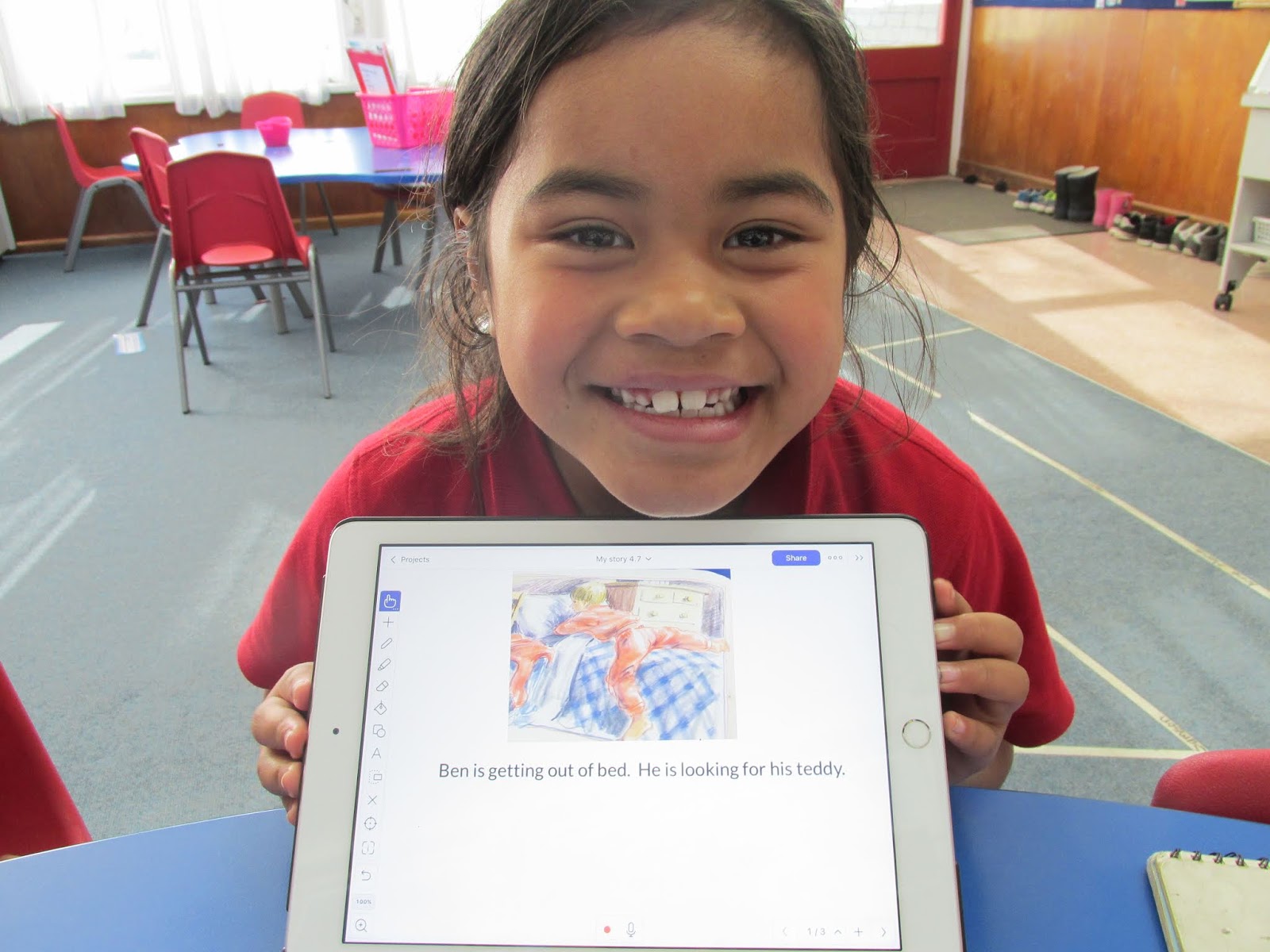 |
| Maggie liked the story about Ben and his teddy. |
 |
| Chevelle wrote about Little Bear riding Monkey's big bike |
Subscribe to:
Posts (Atom)