Sunday, 31 July 2022

Developing Skills With Korero Manaiakalani


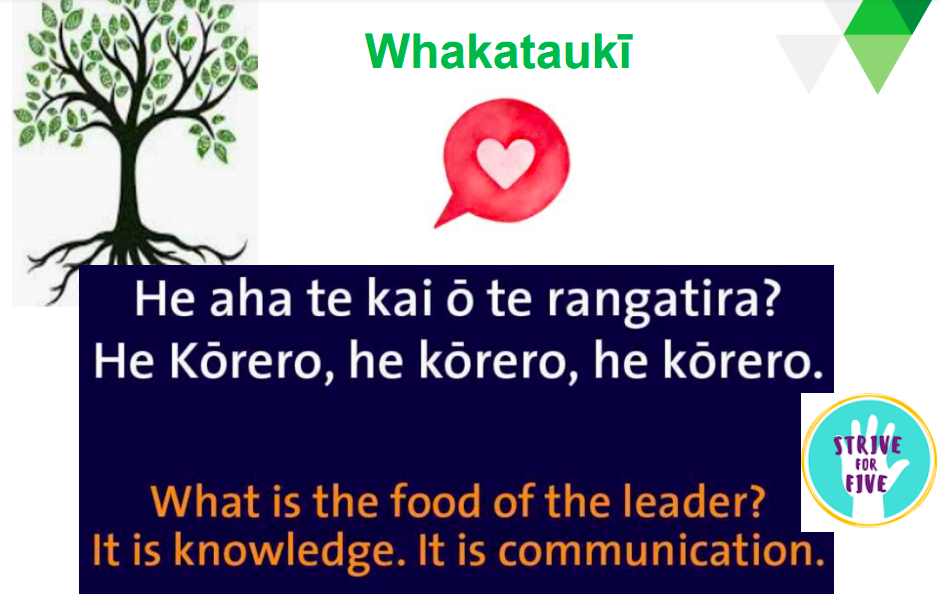
At the beginning of this year Team One was looking at the importance of oral language and we participated in an oral language workshops run by the Speech Language Therapists team Korero Manaiakalani.  The philosophy behind the workshop was to increase oral language skills to "impact wellbeing, participation, learning and achievement."

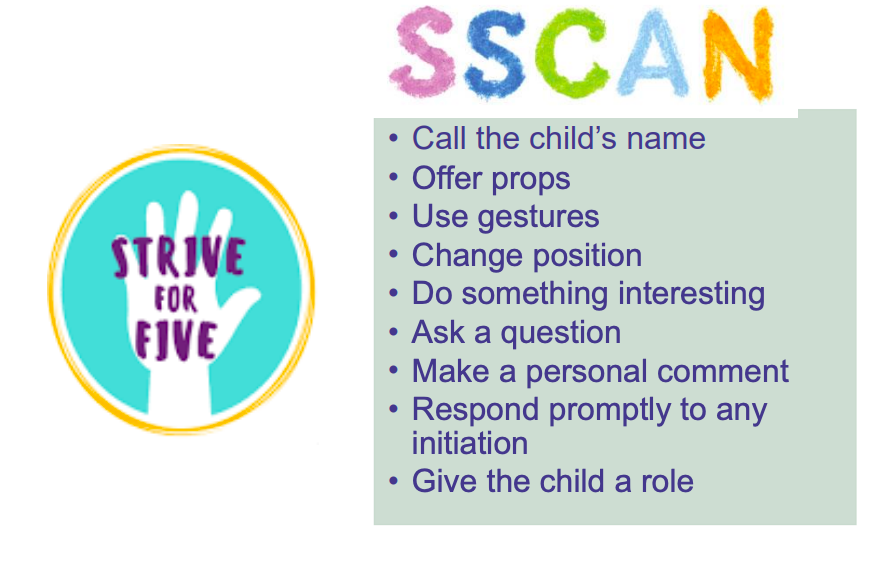
Through using the "Strive For Five" skills, I have become more conscious of the impact of purposeful conversations, quality vocabulary, commenting not questioning and correctly modelling sentences.  This is especially important to keep these skills in mind when introducing new concepts to the children.  

Two of the SSCAN techniques that I found very successful are wait time and validating.  Giving children "thinking time" has resulted in some surprisingly thoughtful comments from children.  It has given them time to organise their thoughts and communicate them successfully.  The children are also learning that "thinking time" or silences are acceptable.   We don't have to fill all silences with further comments while we wait for responses. 


Validating children's comments by repeating or reaffirming what a child said is powerful in showing a child that their comments are valued.  Another method that is powerful is to say the child's name.  It shows we recognise who has made a valued comment.  

Korero Manaiakalani has been a very practical way of helping children become more confident communicators.  I have found the skills are practical to implement within a class setting as well as in groups and it has been exciting to see how important oral language is in helping children become more confident learners.  Good oral skills gives a child a sense of well being and a happy, confident child is ready to participate in their learning. 


Saturday, 2 July 2022

A Visit to Google HQ (NZ)

 Recently Point England staff visited the Google Headquarters in New Zealand.  We were welcomed into their new headquarters and we were impressed by the use of technology to create some amazing work spaces with New Zealand themes.


Steve Smith, the Program Manager of Google for Education in New Zealand gave a presentation of some of the new developments in Google Education.  "Google is a learning company" that believes great learning is accessible to everyone.  It certainly shows this with impressive statistics of 150 million + Google classroom users around the globe.  Google is not just about Chromebooks and computers.  They offer technology and tools to help educators and students.  Hence the new product announcements we were given a preview of.

Two produces that were of great interest to me were the Read along, personalised reading program and the Google Earth Timelapse.

Read along which is coming soon sounds like an exciting aid to help students learn to read.  It has corrective feedback and practice activities and is at many different levels.  There are over 1,000 stories and interactive word games.

Google Earth has always been a fascinating program to look at our earth from space and then zoom in to see a birds eye view of familiar, and not so familiar, places.  Google has now added time lapse photography to its engine.  It is fascinating to see images of how areas develop over time and see history unfold before your eyes. 

Thanks to Google for hosting us and giving us a fascinating incite into further developments

Sunday, 19 June 2022

Manaiakalani "Create" Staff Meeting


Instead of our usual staff meeting we all headed up to Glenn Taylor school for an opportunity to participate in two "Create" Manaiakalani professional development sessions of our choice.  I attended sessions by  


and 


Jo Gormley showed us some story maps produced by her year 1 students based on the story of "The Three Little Pigs".  The students had discussions on sequencing the story and then drew appropriate buildings to retell the story on a map.  They even thought about where the building materials might have come from and drew fields for the hay for the pig to make his house of straw and a forest for the pig to gather the sticks for the house of sticks.  They honed in on Mother Pigs house and discussed and dramatised how Mother Pig would be feeling as the Little Pigs left home.  Apparently even the quieter students became involved as they worked in small groups, words were gifted and all contributions were discussed.  

This is a great technique to expand oral language and in looking at maps made by older students it can be used at any level and can go as "Deep and Wide" as you wish to take it.  Jo got us to work with a partner, using a quote and when we looked at what each group got out of the quote it was amazing how wide ranging the discussions had been and what each group drew as a representation of their take on it.  

For younger children, using a story the children were familiar with, would help with their discussions and understanding for an initial trial of using story maps.  Once they understood what was required, unfamiliar stories could be unpacked and dramatised in a similar way.  This would be a fun way to help our students expand their oral language.

My second session was with Hannah Wast on the use of photography as a creative medium.  Hannah showed us some of the photos taken by students this year at Pt England School.  Having watched these students at work I was amazed at the quality of the children's work - the composition of their photos and the techniques they had used to take the photos was very professional.  The children used a grid to line up their subjects and they obviously thought carefully about what they were going to photograph and what angles they could use to the best advantage.

We were also shown some very creative videos the children made and narrated using lego figures.  They had thought up some great adventures for these figures and filmed them doing these things using the outside area around them.

Unfortunately it was too wet for us to go outside and see what we could find to photograph but we had a go at photographing things in the classroom from odd angles just to see what it was like working with a digital camera and thinking creatively. 

An egg carton!


As our children all have iPads with cameras, it is another creative medium we can use even in the Junior area.  Children get down low and think of all sorts of angles to use and can produce work of a high standard given the opportunity to do so.


Saturday, 21 May 2022

Direction and Position


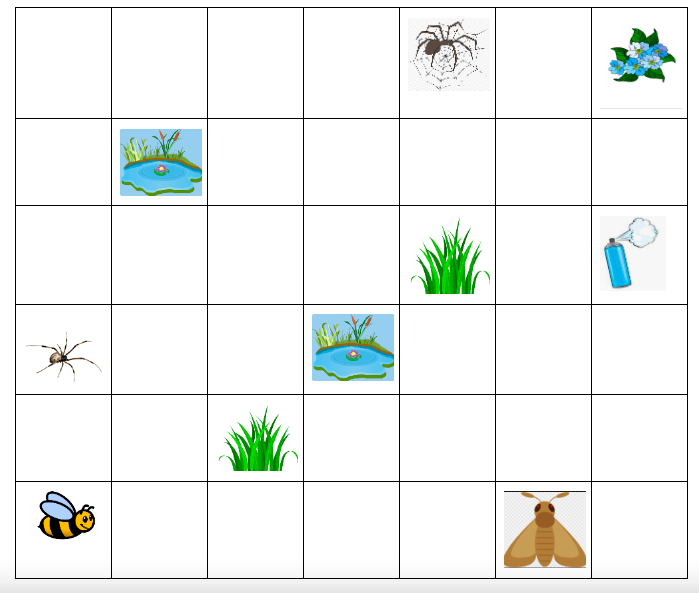
 This term, our Inquiry is based on computational thinking.  We have been learning the vocabulary to describe the position of an object using everyday language such as "left", "right" ,"quarter turn" on a grid using one step or square for each movement.

The children were given a grid to trace a possible route a bee might take to move from one position, across the page to a blue flower following the reading of a PM text "Speedy Bee".  There were several possible routes that "Speedy Bee" could take but the instructions were that the bee was not allowed to fly diagonally across squares and it had to avoid the hazards.  The children were asked to mark their route then describe it to a partner using everyday language.


When it came time to discuss the routes that they had drawn, I found many children had drawn a diagonal line and could not get the concept of moving on a grid using the squares.  How could one quickly demonstrate this concept?  I though about how the children often built with the magnetic shapes forming a grid base so I asked the children to help me build a small grid, counting the sides to make sure it was even.

Then we got out the Duplo blocks, a princess and a cupcake.  The princess was to be moved across the grid to get to the cupcake and each square filled with a Duplo block to show the route she took.  The blocks could not fit into the grid on the diagonal so it forced the children to fill the squares with a block and look at routes that only used forward and backward movements and quarter turns to the left or right.  They quickly caught on to the directional movement and had fun exploring and trying to describe how they moved the princess across the grid.  


We are now looking forward to using the large 100 square that Mr Jacobsen painted for Team one to use.  It will take quite a while to move across all those squares with many possible routes.  Thank you Mr Jacobsen for helping us with our learning.


Saturday, 26 March 2022

Oral Language and Reconnecting


The Strengthening Of Oral Language programme ties in well with the reconnecting with students as they return to school and re engage into school life.  While focusing on their well being, there is no better way of helping a child than having meaningful discussions with them.  The previous few weeks have been ones of disruption to plans and having to "roll with it", but is has also been time when we as teachers have had the luxury of time to look at our teaching practises and make adaptions.

Having a visit by a Speech Language Therapist to demonstrate using the "strive for 5" techniques with both a small group and a larger class group was invaluable.  Analysing the videos of these sessions helped us to see the techniques she used to engage the children and connect at their level.  She -

* repeated or reaffirmed what a child had said (showing a child that their comments were valued)

* made relevant comments on what a child had said

* asked meaningful questions about something the child had said and

* purposefully gifted words 

Learning not only how to use "strive for 5" techniques but also how to analysis, then reflect on your teaching is a powerful tool to use to make changes.

I have thought about when oral language would best fit in with our daily activities and decided that the opportunities that present themselves in play based activities before school would be a good time for "child talk".  I also plan to read to a small group each day to see if this works better than during guided reading time.  Reading to a large class group is often dominated by one or two more orally able children so I will try to read to smaller groups to see if this helps the quiet, shy children.  One of my priorities will be to "observe, wait and listen" and be mindful of the SSCAN technique.


Tuesday, 22 March 2022

Communication and Connectiveness


mask, n.   Covering... for concealing the face...for protection... disguise...

The Concise Oxford Dictionary p748


Unless we were in the medical profession, theatre or certain professions that used safety equipment, masks were not part of our everyday lives.  The arrival of COVID has changed the way we do many things including having to protect ourselves and others through the wearing of a mask.  We have all had to adapt to new ways of doing things.

The first thing one notices when wearing a mask is that they are a barrier.  They are meant to be a barrier between you and others to prevent the spread of disease but one quickly realises they are a barrier for communication in many ways.  They hinder communication  - muffling sounds, you struggle to "read" peoples faces and you feel isolated or hidden behind a mask.  

Making yourself aware of of these "hinderances" means you are able to think of simple solutions to overcome them, communicate effectively and stay connected with your class.  

If you have an accent it is often harder to understand every word.  We rely on visual clues to fill in the gaps.  But if we have noise, a mask and no visual clues it can lead to difficulty in understanding.  Think about background noises in the classroom when you give clear, concise instructions.   

People who are hard of hearing find masks filter out certain sounds especially "ss" and "th" which helps distinguish one word from another.  The higher pitch sounds which are most visible on the lips are often the sounds hearing impaired people have difficulty with. It is also difficult trying to teach young children alphabet sounds with a mask covering the lips.  Face the person and talk as clearly as you can  - common sense things one does without a mask but so much more important with a mask.

Talking with students is even more important to make sure they do not feel isolated or hidden, making sure they understand instructions and have fun learning and doing activities .  Show the children that things have changed but each one of them has something to contribute to the class and that a mask is not a barrier to learning and communicating.

What will I do different when we no longer have to wear masks?  One has become more aware of thinking before giving instructions - it it too noisy, have I got the children's undivided attention, are they looking at me if I use gestures, am I speaking clearly, am I communicating effectively?  It has made us better communicators but we do "talk" and communicate with our faces a great deal.  I am so looking forward to showing a smile with my whole face to my pupils again, feeling the connectivity and not just showing a smile with my eyes.

Communication and connectivity are so much a part of humanity it will be great not to have a barrier hindering this.

Saturday, 19 February 2022

Inquiry 2022: The Importance of Oral Language

Many educationalists believe there is a high correlation between oral language proficiency and success in reading.  Good communication skills give a child confidence and a sense of well being in all aspects of their lives.   

So where does this leave the children who come to school with widely differing oral language capability?  These children  often have a relatively small vocabulary of a mixture of English, their mother tongue and gestures?  How can we mitigate these differences in the classroom setting and make a difference to children's lives? 

I am participating in an oral language workshop run by the Speech Language Therapists team Korero Manaiakalani.  The philosophy behind the workshops is - 

        "Increasing oral language skills for our Tamariki Mokopuna through a strength based approach to collectively impact wellbeing, participation, learning and achievement in our Kahui Ako." 

The action plan from our first session was to attempt to put in place the "Strive for Five" conversation experience with two children in our class.  "Strive for Five" is to have a purposeful conversation with a child where you have five or more exchanges.  During the exchange, you give children two or three opportunities to hear new words in a meaningful context, you ask at least one open ended question and you give a validating response.

By encouraging more talking and drawing out the conversation, a child will hear 

- more quality vocabulary

- grammatically correct sentences

- be given a model of how to ask and answer questions 

- and children learn that their thoughts and ideas are of interest to others.  This encourages them to communicate more which in turn strengthens their oral language even more.

This sounds like a very simple and effective way of helping our children but it is something that needs to be planned for, purposefully done and practised.  I have chosen two children with whom I am actively trying to use the "Strive for Five" technique.  This does not mean I do not use it with the whole class.  One is a lot more conscious of how you engage in conversation with all of the children.

I have been using this technique for a few days.  Sometimes a topic of conversation can arise without planning.  You would normally gift the child words in an ordinary conversation but now you are conscious are your questions open ended or going to close the conversation?  Can you add a personal comment to illicit further conversation?  Do you know something about what the child has commented on?  Can you add to the conversation with some factual information?  All of this takes time to think through.  A teacher will often do some of these actions without thought.  You immediately gift this child with words he or she needs.  It is only later that you think - "I could have asked ... or I could have told the child about ..." all things that would have added to the conversation.    

What happens when a child rejects your invitation to converse and does not engage with you?  What happens when a child does not have the language to begin a simple conversation but relies heavily on gestures to make his wants known?  I am finding in these situations you gift a lot of words and find a way to kindly insert the words into the conversations.  Sometimes there is a repetition of what you offer and there is a reward of a shy smile.  Using photos of the children doing daily activities that have been posted on the class blog has been a great way to start and attempt a "Strive for Five" conversation.  Another time that has been successful is to ask to join in a game or activity they are playing. 

At present I am having to find the time to have a purposeful conversation and planning it in the day so that I can reflect back on it and say perhaps I need to practise this aspect more or I enjoyed practising the questions with that conversation.  Using "Strive for Five" in the classroom looks to be a very practical way of helping children gain a stronger oral language.